Transcription factor dynamics on folded chromatin
How does a transcription factor — a protein that needs to find and bind a specific short DNA sequence among billions of base pairs — locate its target inside a cell nucleus? The classical answer is 3D diffusion. But chromatin, the DNA–protein complex that packages the genome, is not a simple solution: it folds into specific 3D structures that could either help or hinder the search.
This project provides the simulation code for the paper:
Theoretical principles of transcription factor traffic on folded chromatin R. Cortini & G. J. Filion Nature Communications, 2018 doi.org/10.1038/s41467-018-05765-0
The model
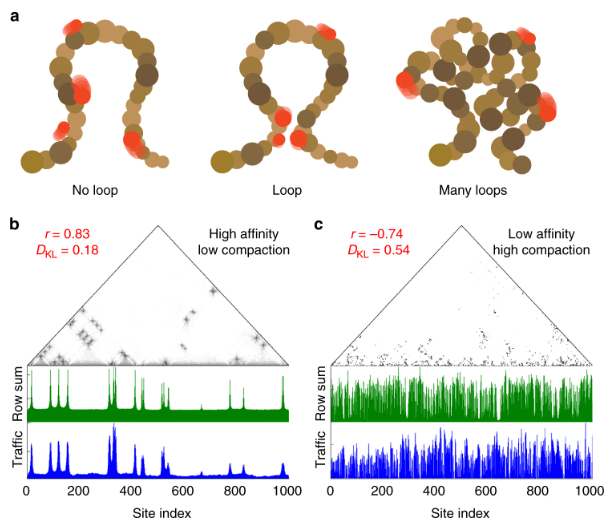
Chromatin folding is described using the Strings and Binders Switch (SBS) model, in which the polymer (DNA) folds into specific 3D conformations driven by bridging proteins. On top of this folded structure we simulate tracers — diffusing particles that represent transcription factors searching for their targets.
Four scenarios are modelled:
| Simulation type | What it tests |
|---|---|
| Monovalent | Single-binding-site tracers on folded chromatin |
| Multivalent | Multi-site tracers; basis for Figures 2–5 in the paper |
| Crowding | Effect of molecular crowding on tracer dynamics |
| Varying diameter | How tracer size affects search efficiency |
Implementation
All simulations are written in Python and run on top of HOOMD-blue, a general-purpose particle simulation toolkit developed at the University of Michigan. HOOMD-blue is optimised for GPU execution via CUDA, making it possible to run the large numbers of independent simulation trajectories needed to collect reliable statistics on stochastic search processes.
Trajectory analysis uses MDAnalysis, a widely-used open-source library for processing molecular dynamics output.
Full dependency stack — all free and open-source:
| Tool | Role |
|---|---|
| HOOMD-blue v2.1+ | GPU-accelerated particle simulation engine |
| MDAnalysis v0.17+ | Trajectory parsing and analysis |
| GSD | Compact binary format for topology and trajectories |
| NumPy · SciPy | Numerical processing |
Reproducibility
The repository at github.com/rcortini/sbs_tracers contains all the code needed to reproduce every simulation figure in the paper. Each simulation type maps directly to a specific figure or supplementary note, documented in the README. Running a simulation requires only:
python sbs_tracers.py <options>and analysis of the resulting .gsd trajectory file:
python script.py trajectory.gsd <options>This was an early personal commitment to reproducible research: every number in the paper comes from code that is publicly available, version-controlled, and runnable by anyone with access to a GPU.